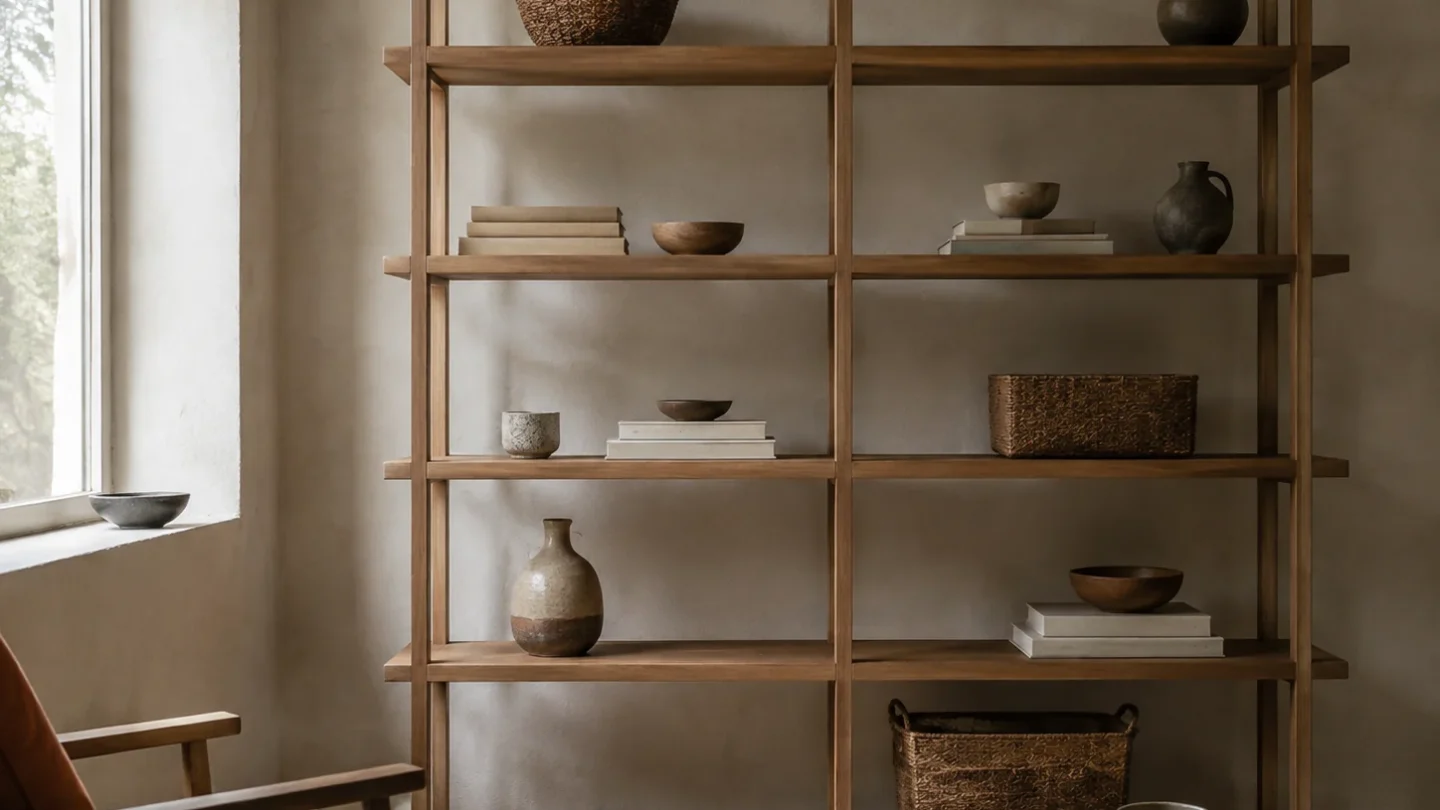
Open shelves are most successful when they hold a limited category of objects and leave enough air for each group to read clearly.
Begin with what the shelf needs to do
Decide whether it stores books, dishes, daily supplies, or display pieces. Mixing every category together creates visual noise and makes the practical items harder to reach.
Use containers for the small things
Two or three matching baskets can hold cables, papers, and loose tools. Keep their color close to the shelf or wall so the larger composition stays quiet.
Vary the shape, repeat the material
A stack of books, a rounded ceramic piece, and one framed work create contrast. Repeating wood, clay, or a single metal finish ties different shapes together.
Leave deliberate gaps
Negative space is not wasted storage. It helps the eye understand each group and makes the full unit feel lighter in a compact room.
When editing, remove everything and return only the pieces you use or genuinely enjoy. Stop before every shelf looks complete; a little asymmetry keeps the arrangement natural.
Community
Join the conversation
Add a useful idea, ask a specific question, or share what worked in your space. Every comment is reviewed before it appears.